


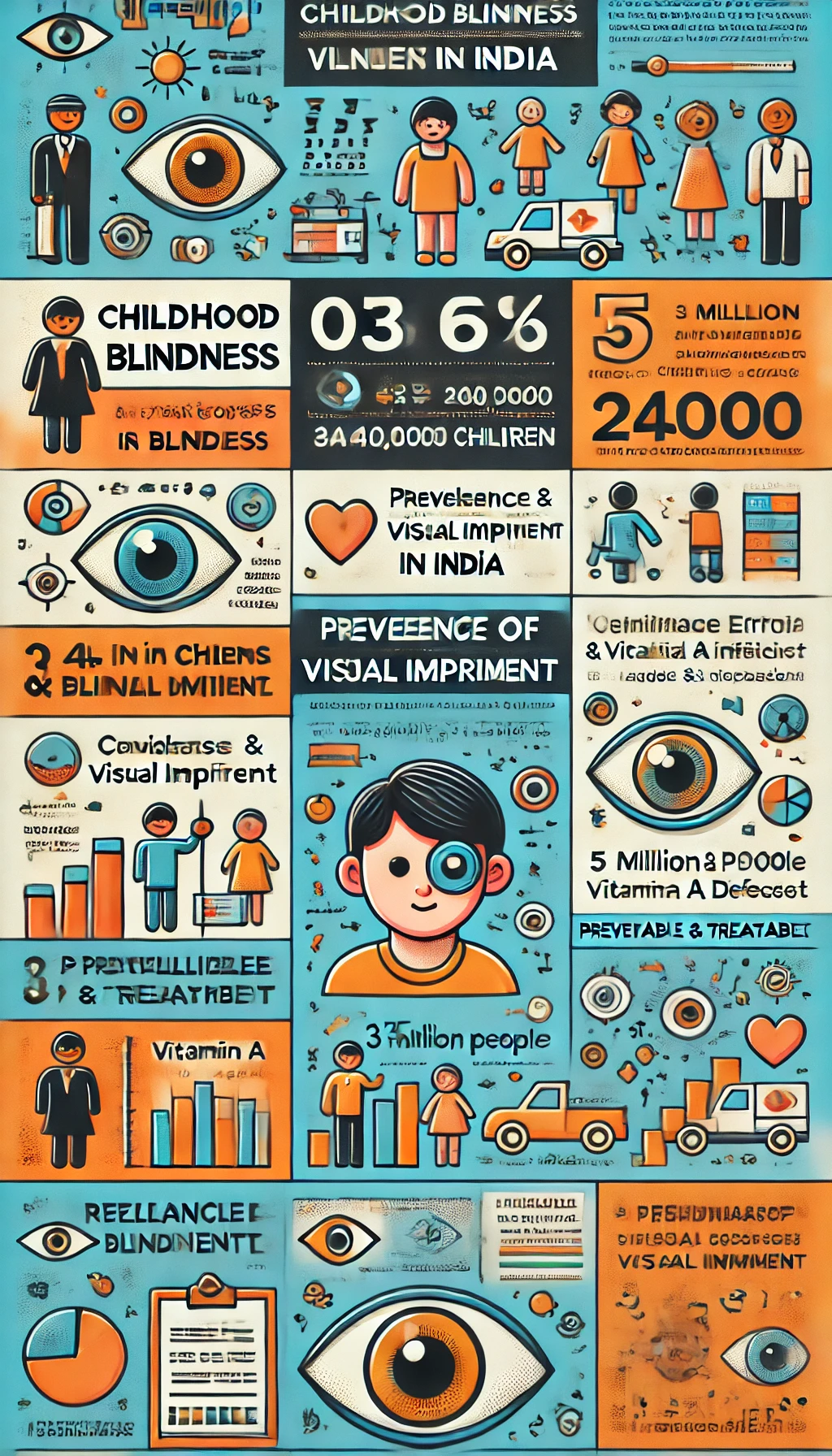
Approximately 0.36% of the Indian population is blind, including an estimated 240,000 blind children. About 1 in 1000 children between 0-15 years are blind.
Around 35 million people in India are visually impaired, representing 2.55% of the population.
Refractive errors, such as myopia (nearsightedness), are a leading cause of visual impairment and blindness in children.
Other causes include amblyopia (lazy eye), congenital eye anomalies, vitamin A deficiency, and corneal diseases.
A significant portion of childhood blindness and visual impairment in India is preventable or treatable, particularly through early detection and management of refractive errors and other conditions.
At the Khetarpal Multi-Speciality Hospital, we provide specialized care for pediatric eye conditions. Early detection and treatment are essential for healthy vision development in children. Our expert pediatric ophthalmologists diagnose, monitor, and treat a wide range of pediatric eye disorders with precision and compassion.
Children with:
Symptoms like poor vision, eye pain, unusual eye size/shape, crossed or wandering eyes, or an abnormal pupil appearance
Pediatric ophthalmology is a subspecialty of ophthalmology that focuses on diagnosing and treating eye conditions in children from birth to 18 years old.
Every child is unique, and our approach supports their physical, emotional, and social well-being. We work closely with families to provide education, support, and treatment options tailored to each child’s needs.
Our pediatric ophthalmologists collaborate with pediatric neurologists, neuroradiologists, otolaryngologists, and neonatologists to provide comprehensive care for complex eye conditions.
We value parents’ insights and work closely with families to develop personalized treatment plans for optimal outcomes.
Lens opacity present at birth or shortly after, potentially leading to vision loss. Causes include genetic factors and maternal infections.
Decreased vision in one eye due to abnormal visual development. Early treatment is essential to improve vision.
Misalignment of the eyes, which may cause eye strain and vision issues. Treatment options include surgery, lenses, vision therapy, and eye patching.
Blocked tear ducts can lead to excessive tearing and discharge. Treatment options range from medication to surgical correction.
Vision problems caused by improper focusing of light on the retina. Corrected with glasses, contact lenses, or refractive surgery.
Abnormal retinal blood vessel growth in premature infants, potentially leading to blindness if untreated.
A contagious eye infection causing redness, irritation, and discharge. Requires timely treatment, especially in newborns.
A red, painful bump on the eyelid caused by bacterial infection of an oil gland. Typically treated with warm compresses or antibiotics.
We offer specialized eye care for all ages, from newborns to older adults. Choose the appropriate category to learn more about our treatments. At Khetrapal multispeciality hospital we offer eye treatment that can treat all ages from newborns to old age.
A congenital cataract is a lens opacity (cloudiness) that is present at birth or develops shortly after. Congenital cataracts can range in severity, from mild opacities with minimal vision impairment to severe cases causing significant vision loss. They can be caused by genetic factors, maternal infections during pregnancy (like rubella), or other factors that affect the development of the lens.
Lazy eye is decreased vision in one or both eyes due to abnormal development of vision in infancy or childhood. Vision loss occurs because nerve pathways between the brain and the eye aren’t properly stimulated. The brain “learns” to see only blurry images even when glasses are used. As a result, the brain favors one eye, usually due to poor vision in the other eye. The medical term for lazy eye is called “Amblyopia.” It is the leading cause of vision loss amongst children.
A squint, also known as strabismus, is a condition where the eyes are misaligned and point in different directions. It can affect one or both eyes. Symptoms vary from difficulty focusing on objects, frequent eye strain or headaches, squinting or tilting the head to see clearly to inconsistent vision clarity, And, its causes could range from genetics, nerve damage during delivery, to dysfunctional eye muscles. The type of surgery to be performed is dependent on each individual’s presentation and severity. Other methods to treat this depend on the degree of the squint and could involve the use of prisms, refractive lenses, vision therapy, eye patching, and even certain medications.
Tears normally drain through small openings in the corners of the upper and lower eyelids called puncta and enter the nose through the nasolacrimal duct. Tear duct obstruction prevents tears from draining through this system normally. If the tear duct is blocked, there will be backflow of tears and discharge from the eye.
Know the Treatment
In order to see clearly, light rays from an object must focus onto the inner back layer of the eye. The eye works like a camera. It has an opening at the front (the pupil), a focusing mechanism (the cornea and crystalline lens), and a light-sensing portion at the back (the retina). If light rays are not focused on the retina, a refractive error is present.
Retinopathy of prematurity (ROP) is a potentially blinding disease caused by abnormal development of retinal blood vessels in premature infants. The retina is the inner layer of the eye that receives light and turns it into visual messages that are sent to the brain. When a baby is born prematurely, the retinal blood vessels can grow abnormally. Most ROP resolves without causing damage to the retina. When ROP is severe, it can cause the retina to pull away or detach from the wall of the eye and possibly cause blindness. Babies 1250 grams or less and are born before 31 weeks gestation are at highest risk.
Conjunctivitis or “pink eye” is a condition where the eyes look pink or red and may have discharge. Symptoms may include burning, itching, irritation, discharge, or crusting of the lashes. Conjunctivitis can be infectious among children. If Conjunctivitis occurs in newborns due to the presence of bacteria in the birth canal, immediate treatment is required and critical to preserve eyesight
A stye, also known as a hordeolum, is a painful, red bump on the eyelid caused by a bacterial infection of an oil gland or eyelash follicle. They often look like a pimple and can be filled with pus. They can occur on the outside or inside of the eyelid, near the base of the eyelashes. Common symptoms include redness, swelling, tenderness, and a feeling of something in the eye. A warm compress, or prescribed antibiotics or ointment can often help clear it. However, in rare cases, a surgical incision may be required.
Conjunctivitis or “pink eye” is a condition where the eyes look pink or red and may have discharge. Symptoms may include burning, itching, irritation, discharge, or crusting of the lashes. Conjunctivitis can be infectious among children. If Conjunctivitis occurs in newborns due to the presence of bacteria in the birth canal, immediate treatment is required and critical to preserve eyesight
A stye, also known as a hordeolum, is a painful, red bump on the eyelid caused by a bacterial infection of an oil gland or eyelash follicle. They often look like a pimple and can be filled with pus. They can occur on the outside or inside of the eyelid, near the base of the eyelashes. Common symptoms include redness, swelling, tenderness, and a feeling of something in the eye. A warm compress, or prescribed antibiotics or ointment can often help clear it. However, in rare cases, a surgical incision may be required